


Built to Be Used Again: Why Reusable Display Systems Make Better Event Branding
For years, event branding has often followed a familiar pattern: create something for a campaign, use it at an event, dismantle it and start again the next time.
But does every new event really need a completely new display?
As sustainability becomes a bigger consideration for event organisers, exhibitors and brands, attention is shifting from what a display is made from to something equally important: how long it stays in use.
The Event Greening Forum recently explored this idea in its Stop Buying Cheap. Start Buying Once. feature on Gawk, looking at why investing in durable, reusable display solutions can reduce waste over the longer term.
It is a simple idea, but one that can change the way businesses approach event branding.
Sustainability Starts Before the Event
It is easy to think about sustainability only when an event is finished.
Where will the banners go? Can the graphics be recycled? How much waste was generated during breakdown?
Those questions matter, but some of the most important decisions have already been made long before the event doors open.
The Event Greening Forum’s own guidance encourages exhibitors to consider reusable banners and signs, recyclable materials and exhibition designs that reduce unnecessary waste. Its Gauteng Green Events Guidelines specifically recommend making signage generic where possible so that it can be reused at future events.
That means the design brief itself matters.
Instead of asking only, “What do we need for this event?”, it can be useful to ask:
“How could we use this again?”
Start With Hardware That Has Another Event in It
One of the biggest advantages of a reusable display system is that the main structure does not have to change every time the campaign does.
A company may attend an exhibition in Johannesburg this month, launch a product in Cape Town three months later and take part in a conference towards the end of the year.
The event spaces may be different. The messaging may change. The graphics may need updating.
The underlying display hardware, however, can often continue working.
TRIGA® Max, for example, is a modular textile display system designed so components can be arranged in different configurations. Extra components can be added as requirements change, while the main hardware remains in use. Gawk describes the system as scalable, sturdy, durable and reusable, with its major components also recyclable at the end of their useful life.
This is a very different approach from a display designed for one specific event and discarded afterwards.
Change the Graphics, Not the Whole Display
Brands change.
Campaigns end, products are launched, marketing messages are refreshed and visual identities evolve.
That does not necessarily mean the entire display structure has to become obsolete.
With systems such as TRIGA® Go, textile graphics can be removed and replaced while the hardware continues to be used. The same system can be configured as display walls, towers, counters and small-to-medium exhibition stands. Some configurations even allow the same hardware to carry different branding for different teams or applications.
This separation between the structure and the message is important.
The durable part of the display can stay in circulation while the part that naturally changes — the branding — can be updated when necessary.
It gives marketing teams greater flexibility without automatically turning every campaign change into a completely new hardware purchase.
Modular Design Can Extend Useful Life
Reusable does not simply mean using exactly the same stand again and again.
A display also needs to remain useful when circumstances change.
Your next exhibition space might be smaller. A future event might require a longer branded wall. A retail activation might need counters rather than an exhibition booth. A roadshow may need something that can be transported and assembled quickly.
Modular design allows existing components to be rearranged, extended or combined in different ways.
That adaptability is an important part of keeping products in use.
Circular-economy principles place a strong emphasis on maintaining, reusing, repairing and refurbishing products before recycling them. Keeping a complete product useful for longer retains more of its value than immediately reducing it back to raw material.
For event displays, that means reconfiguration can be just as important as recyclability.
Think About What Happens to Old Graphics
Even with reusable hardware, printed graphics will eventually reach the end of a campaign.
That does not necessarily mean they immediately become waste.
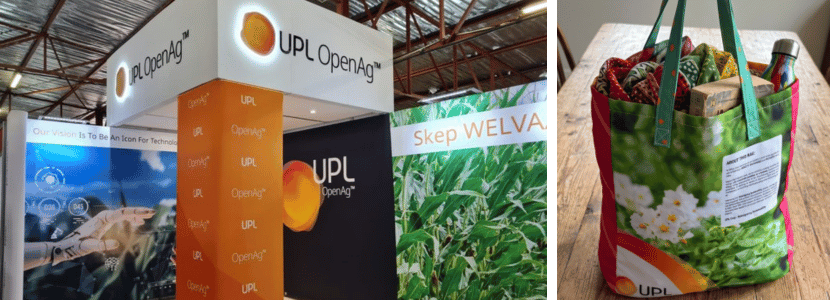
In the Event Greening Forum feature, Gawk shared the example of UPL, which has used the same TRIGA® Max structural system for five years without discarding structural components. When some of the textile graphics became outdated, Gawk’s upcycling programme transformed the material into more than 500 shopper bags.
It is a useful example of thinking beyond the first use of a material.
The original graphic may no longer be suitable for an exhibition wall, but the material itself can still have value.
The aim should be to keep products and materials useful for as long as practical, and only move to recycling when higher-value reuse options have been exhausted.
Quality Matters When You Plan to Reuse
A reusable strategy only works if the products are designed to withstand repeated use.
Display systems may be transported, assembled, dismantled, packed away and then assembled again many times during their working life.
Hardware therefore needs to be robust enough for repeated handling. Graphics need to remain presentable. Components should be replaceable or adaptable where possible.
This is why the cheapest option at the quotation stage is not always the most sensible way to judge a display.
The more useful question is whether the solution is designed for the way your business actually exhibits.
- Will it work at more than one event?
- Can the branding be updated?
- Can it be transported efficiently?
- Can the configuration change?
- Can individual elements be replaced without discarding the entire display?
Those questions provide a much better picture of long-term value.
One Display Can Have More Than One Job
Reuse can also mean looking beyond exhibitions.
A modular display wall might later be used for a conference, media backdrop, showroom or corporate presentation. A branded counter could move between exhibitions, retail activations and product launches.
Gawk’s display range extends across exhibitions, retail, promotions and other branded environments, while products such as portable counters are specifically designed with interchangeable graphics so they can be rebranded without replacing the hardware.
The more ways a display can be used, the less likely it is to spend most of its life sitting in storage — or being discarded because it no longer suits one particular campaign.
Design for the Next Event Too
Sustainable event branding does not have to mean compromising on visual impact.
It can simply mean planning further ahead.
Choose durable hardware. Keep structures flexible. Update graphics rather than replacing complete systems. Look for opportunities to repurpose materials, and consider what will happen to each element when it eventually reaches the end of its useful life.
As the Event Greening Forum’s recent feature on Gawk puts into focus, sometimes the better sustainability decision is not continually searching for another disposable alternative.
It is choosing something designed to keep working.
At Gawk, we develop reusable, modular branding and display solutions for exhibitions, events, retail environments and activations. Talk to our team about creating a display system that can adapt to more than one campaign, space or event.
Frequently Asked Questions
Can exhibition display systems be reused for different events?
Yes. Modular display systems can often be reconfigured for different stand sizes, layouts and event types. This allows the same core hardware to be used across exhibitions, conferences, activations and other branded environments rather than starting from scratch each time.
Can you change the graphics without replacing the display hardware?
Yes. Systems such as TRIGA® use replaceable textile graphics, allowing branding or campaign messaging to be updated while the main display structure remains in use. This can be especially useful for businesses that exhibit regularly or run different campaigns throughout the year.
Are modular exhibition displays more sustainable than single-use displays?
They can be, particularly when they are designed for repeated use. Reusing durable hardware, adapting layouts and replacing only the graphics when necessary can reduce the need to manufacture and dispose of complete display systems for each event.
What can happen to old textile display graphics?
Depending on the material and its condition, old graphics may be reused, repurposed or recycled. Gawk has previously upcycled outdated textile display graphics into items such as shopper bags, helping to extend the useful life of the material beyond the original event.